
You Are Here: Home » Rules of Table Tennis » Terminology / Glossary
Table Tennis Terminology
Do you know your table tennis terminology
or are you confused by your chops, pimples and twiddles?
By Martin Hughes
Owner and Editor
GREAT GIFTS
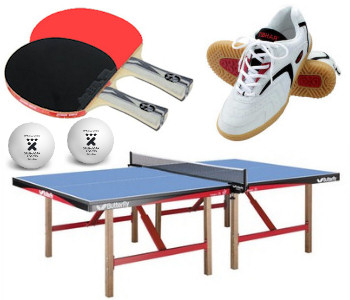
Portable Table Tennis Table...
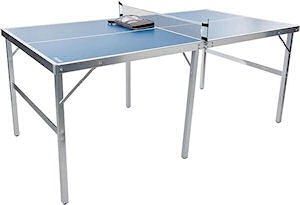
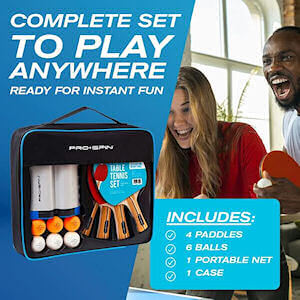
Table Tennis Net, Rackets, Ball and Case...
These are all common table tennis terms, and if you're serious about playing the game, you'll need to understand all the terminology that your opponents are using.
So here's your opportunity to start learning the definition of table tennis terms with my table tennis glossary to help you on your way...
If you don't find the table tennis term you're looking for, please contact me.
Need your questions about the Rules and Regulations answered SIMPLY and CLEARLY?
Take a look at this fully up-to-date downloadable book. You'll find everything you need.
Get all the details here...
TABLE TENNIS EXPERT
REVEALS HIS SECRETS
Click Here For Details

Click here for a large selection of
table tennis equipment at Megaspin *
Click here for a large selection of
table tennis equipment at Bribar *
TABLE TENNIS EXPERT
REVEALS HIS SECRETS
Click Here For Details
Click here for a large selection of
table tennis equipment at Megaspin *
Click here for a large selection of
table tennis equipment at Bribar *
| A | |
| ALL, ALL-, ALL+ | Abbreviation/description for an ALLround style blade. It's a manufacturers' indication of the blade speed and style. Generally means a medium speed blade with good control. Adding a + or - sign indicates a slightly faster or slower speed. |
| Anti or Anti-loop or Anti-spin |
A smooth rubber with very low surface friction, used to defend against excessive spin or to confuse the opponent. This type of rubber deactivates spin and speed, returning a "dead" ball. |
| Assistant Umpire | The person appointed to assist the umpire with certain decisions. |
^ Top of page ^ |
|
| B | |
| Backhand | A shot executed where the back of your hand is pointing towards the opponent, to the left of the elbow for a right handed player and vice versa for a left handed player. |
| Backspin | A type of spin used mostly on defensive shots. When you chop down on the ball, you produce backspin. The bottom of the ball will move away from you. |
| Bat | An alternative name for the racket. |
| Blade | The wooden part of the racket. |
| Block | A topspin shot played close to the table with the racket making contact with the ball just after it bounces. |
| Blocker | A style of play where use of the block is the primary stroke. |
^ Top of page ^ |
|
| C | |
| Cho / Choi | Verbal expression of self encouragement used by some players during a match. |
| Chop | A defensive return of a topspin stroke played with backspin, usually well away from the table. |
| Chopper | A style of play where use of the chop is the primary stroke. |
| Chop Block | A stroke played close to the table where the racket makes contact with the ball (just after it bounces) with a fast downward vertical motion to create backspin. Made popular by Jan-Ove Waldner. |
| Closed Racket | A stroke played with the striking surface of the racket angled downwards, eg. a topspin stroke or block. |
| Counter-loop | A loop stroke played in response to a loop stroke from your opponent. |
| Counter-smash | A smash stroke played in response to a smash stroke from your opponent. |
| Cross-court | A stroke that's hit diagonally from corner to corner. |
| Crossover Point | The area in which the player has no obvious choice of forehand or backhand. For a right handed player, the crossover point is roughly in line with the right hip. |
^ Top of page ^ |
|
| D | |
| Dead ball | A stroke played which returns the ball with very little, or no spin. |
| Deep | Playing any shot which causes the ball to bounce very near to your opponents end of the table. |
| DEF, DEF-, DEF+ | Abbreviation/description for a DEFensive style blade. It's a manufacturers' indication of the blade speed and style. Generally means a slower speed blade with more control. Adding a + or - sign indicates a slightly faster or slower speed. |
| Double Bounce | When the ball bounces twice on one side of the table before a return is made, causing that player to lose the point. |
| Doubles | A game of table tennis where two people play on each side and alternate turns at striking the ball. |
| Down the line | A stroke that's played where the ball travels parallel to the sidelines of the table. |
| Drive | A stroke played close to the table with your racket arm moving forward and slightly upwards in the direction that the ball is going to travel. |
| Drop shot | A shot which drops very short over the net on your opponent's side of the table. Usually played when your opponent is positioned away from the table. |
^ Top of page ^ |
|
| E | |
| Early | Playing a stroke (during a rally) that makes contact with the ball just after it bounces. |
| Expedite | A rule which comes into operation if a game is unfinished after 10 minutes play (or at any earlier time at the request of both players or pairs). Thereafter, each player shall serve for one point in turn and if the receiving player or pair makes 13 returns, the receiver shall score a point. |
^ Top of page ^ |
|
| F | |
| Flat | Playing a stroke with minimum topspin so that the ball travels very low over the net. |
| Flick or Flip |
A stroke played close to the table where you hit over the back or top of ball, using a loose wrist action to impart topspin. |
| Float | A stroke played which returns the ball with very little, or no spin. Particularly used by players who use a defensive style of play in order to deceive their opponent. |
| Forehand | A shot executed where the palm of your hand is facing your opponent, to the right side of the elbow for a right handed player and vice versa for a left handed player. |
| Free Hand | The hand not holding the racket. |
| Funny Rubbers or Funny Bat / Racket |
See Long Pimples |
^ Top of page ^ |
|
| G | |
| Game | A game is won by the player or pair first scoring 11 points unless both players or pairs score 10 points, when a game shall be won by the first player or pair subsequently gaining a lead of 2 points. |
| Gluing-up | The act of affixing table tennis rubbers to the blade with table tennis glue (particularly with "speed" glue which was repeated at regular intervals in order to increase the playing speed of the rubber, but this is no longer permitted). |
| Gossima | Early versions of table tennis (1890-1926) were made by several different manufacturers, with each manufacturer using an exclusive patented or trademarked name for their own version. These included "Indoor Tennis", "Gossima", "Whiff-Waff" and "Ping Pong". |
^ Top of page ^ |
|
| H | |
| Half-long service | A service where the second bounce on your opponent's side of the table (if the ball was not hit by your opponent) is at or very near their end line of the table. |
| Handicap Event | An event in a tournament where players are graded or ranked according to ability so that they can compete equally. The weaker player will not have to score as many points as the stronger player to win a game. |
| Heavy | Used to describe excessive spin. |
| High Toss Serve | A serve where the ball is thrown high into the air. This helps the server to increase the amount of spin and speed imparted onto the ball. |
^ Top of page ^ |
|
| I | |
| ITTF | International Table Tennis Federation - the international governing body for the sport of table tennis. |
| Inverted rubber | The most common racket covering. It consists of a sheet of rubber on top of a layer of sponge. The pimples (pips) face inward, so the playing surface is smooth. |
^ Top of page ^ |
|
| J | |
| Junk Rubbers or Junk Bat / Racket |
See Long Pimples |
^ Top of page ^ |
|
| K | |
| Kill | An aggressive shot hit with too much speed for the opponent to return it. |
^ Top of page ^ |
|
| L | |
| Late | Playing a stroke (during a rally) that makes contact with the ball when the ball is descending rather than rising. |
| Let | A rally where the result is not scored. |
| Let Serve | If the ball touches the net, provided the service is otherwise good, the serve is replayed - or - if your opponent is not ready, the serve is replayed. |
| Loaded | Used to describe excessive spin. |
| Lob | A defensive shot used against high-speed shots, where the ball is returned very high in the air. |
| Long | Playing any shot which causes the ball to bounce very near to your opponent's end of the table. |
| Long Pimples (Pips) |
A type of racket covering. A sheet of rubber on top of a layer of sponge. The pimples (pips) face outwards, so the playing surface is pimpled. Depending on the length and hardness of the pimples, unusual types of spin can be imparted. |
| Loop | An attacking stroke where excessive topspin is imparted onto the ball. This enables you to hit the ball harder as the topspin will help you keep the ball in play. |
| Looper | A style of play where use of the loop is the primary stroke. |
| Loose return | A return shot that is either too high, too long, has insufficient spin or a combination of these and therefore makes it easy for your opponent to attack or kill. |
^ Top of page ^ |
|
| M | |
| Match | A match consists of the best of any odd number of games (usually 3, 5 or 7). |
| MD | Abbreviation for Men's Doubles in a tournament. |
| MS | Abbreviation for Men's Singles in a tournament. |
| Multi-ball | A training method that minimizes wasted time by using a continuous supply of table tennis balls instead of just one ball. |
^ Top of page ^ |
|
| O | |
| OFF, OFF-, OFF+ | Abbreviation/description for an OFFensive style blade. It's a manufacturers' indication of the blade speed and style. Generally means a faster speed blade with less control. Adding a + or - sign indicates a slightly faster or slower speed. |
| Obstruction | A player obstructs the ball if he or she, or anything he or she wears or carries, touches it in play when it is above or travelling towards the playing surface, not having touched his or her court since last being struck by his or her opponent. |
| Open Racket | A stroke played with the striking surface of the racket angled upwards, eg. a push or backspin shot. |
| OX | Abbreviation/description for a rubber with no sponge underneath, i.e. Orthodox. |
^ Top of page ^ |
|
| P | |
| Paddle | An alternative name for the racket. |
| Penhold | A style of grip in which the racket handle is held between the thumb and forefinger. Used mainly by Asian players. |
| Pimples (Pips) |
A type of racket covering. A sheet of rubber on top of a layer of sponge. The pimples (pips) face outwards, so the playing surface is pimpled. Depending on the length and hardness of the pimples, unusual types of spin can be imparted. |
| Ping Pong | Early versions of table tennis (1890-1926) were made by several different manufacturers, with each manufacturer using an exclusive patented or trademarked name for their own version. These included "Indoor Tennis", "Gossima", "Whiff-Waff" and "Ping Pong". "Ping Pong" is still a trademarked name in the USA, but is often used interchangeably with "table tennis" by the general public. |
| Playing Surface | The upper surface of a table tennis table which lies in a horizontal plane 76cm (2ft 6in) above the floor. |
| Point | A unit of scoring in table tennis. A rally where the result is scored. |
| Push | A backspin shot usually executed over the playing surface. |
^ Top of page ^ |
|
| R | |
| Racket | The equipment used to hit the ball. Comprises of a wooden blade with rubbers affixed to it. |
| Racket hand | The hand that is holding the racket. |
| Rally | The period during which the ball is in play. |
| Ranking / Rating | A method of evaluating the playing abilities of different players in relation to each other. |
| Ranking Event | An event in which the results will be used to calculate a player's ranking. |
| Receiver | The player due to strike the ball second in a rally. |
| Referee | The person appointed to control a tournament. |
| Re-glue | The act of affixing table tennis rubbers to the blade with table tennis glue (particularly with "speed" glue which was repeated at regular intervals in order to increase the playing speed of the rubber, but this is no longer permitted). |
| Reverse rubber | The most common racket covering. It consists of a sheet of rubber on top of a layer of sponge. The pimples (pips) face inward, so the playing surface is smooth. |
| Rubber | The racket covering. Sometimes refers only to the rubber on top of a sponge base. |
^ Top of page ^ |
|
| S | |
| Sandwich Rubber | A type of racket covering. A racket covering with pimples inwards or outwards on top of a layer of sponge, having a total thickness including adhesive of not more than 4mm. |
| Seed / Seeding | Rank the strongest/best players and assign them to a position in the draw so that they do not meet in the early rounds of a knockout competition. |
| Server | The player due to strike the ball first in a rally. |
| Service | The start of a point where one player strikes the ball. |
| Shakehand | A style of grip in which the racket handle is held in the palm of your hand so that the start of the racket head fits snugly into the "V" shape formed by your thumb and first finger - similar to shaking hands with another person. |
| Short | Playing any shot which causes the ball to bounce very near to the net and, if not hit by your opponent, would bounce at least twice on the table. |
| Short pimples (Pips) |
A type of racket covering. A sheet of rubber on top of a layer of sponge. The pimples (pips) face outwards, so the playing surface is pimpled. Depending on the length and hardness of the pimples, unusual types of spin can be imparted. |
| Sidespin | A type of spin imparted onto the ball causing it to move left or right before and after it strikes the playing surface. |
| Smash | An aggressive shot hit with speed, often in response to a high bouncing return. |
| Speed Glue | A type of glue used to affix table tennis rubbers to the blade. Previously used at regular intervals in order to increase the playing speed of the rubber, but this is no longer permitted. |
| Spin | The rotation of the ball. A player can impart spin onto the ball by using a brushing action with the racket surface. |
| Sponge | A type of racket covering used in sandwich rubbers. It is used under a sheet of rubber with pimples. First seen in 1952 when Japan's Hiroji Satoh astonished the world with his unexpected victory in the men's singles of the World Championship that year. |
| Strike | Touching the ball in play with your racket, held in your racket hand, or with your racket hand below the wrist. |
| Stroke | Any shot used by a player in a game. |
| Sweet spot | The portion of the racket (usually near the centre) which produces the best response. |
^ Top of page ^ |
|
| T | |
| Third ball or Third ball attack |
The stroke played by the server after the opponent's return of the serve. Because the serve can be used to make attacking difficult for the opponent, the third ball is frequently the first strong attacking stroke in any table tennis rally. |
| Tight | Playing any shot which makes it difficult for your opponent to attack. |
| Topspin | A type of spin imparted onto the ball causing it to arc over the net and down onto the table surface. |
| Twiddle | The act of turning the racket in your hand in order to use different sides of the racket to strike the ball. Usually only used by players who have different rubbers on each side of their racket in order to deceive their opponent. video demonstration of twiddling |
^ Top of page ^ |
|
| U | |
| Umpire | The person appointed to control a match. |
| Underspin | A type of spin used mostly on defensive shots. When you chop down on the ball, you produce underspin. The bottom of the ball will move away from you. |
^ Top of page ^ |
|
| V | |
| Volley | Hitting the ball before it bounces on your side of the table. A player who volleys the ball generally loses the point. |
^ Top of page ^ |
|
| W | |
| Whiff-Waff | Early versions of table tennis (1890-1926) were made by several different manufacturers, with each manufacturer using an exclusive patented or trademarked name for their own version. These included "Indoor Tennis", "Gossima", "Whiff-Waff" and "Ping Pong". |
| WD | Abbreviation for Women's Doubles in a tournament. |
| WS | Abbreviation for Women's Singles in a tournament. |
^ Top of page ^ |
|
| X | |
| XD | Abbreviation for Mixed Doubles in a tournament. |
^ Top of page ^ |
|
I hope that this list of table tennis terminology has helped your understanding of this great sport of table tennis.
If you don't find the table tennis term you're looking for, please contact me.
Need your questions about the Rules and Regulations answered SIMPLY and CLEARLY?
Take a look at this fully up-to-date downloadable book. You'll find everything you need.
Get all the details here...
^ Top of page ^
| MORE PAGES ABOUT THE RULES OF TABLE TENNIS |
|---|
For more information about the rules of table tennis, take a look at my other articles which explain the Official
Laws of Table Tennis and the additional Regulations (for higher level play) in more detail...
The Laws of Table Tennis
Regulations (for higher level play)
General
Frequently Asked Questions
|
Click here for a large selection of
table tennis equipment at Megaspin *
Click here for a large selection of
table tennis equipment at Bribar *
^ Top of page ^
You Are Here: Home » Rules of Table Tennis » Terminology / Glossary