
You Are Here: Home » How to Play Table Tennis » 4 Basic Strokes
Table Tennis Stroke
A good table tennis stroke will dramatically improve your game.
Discover how you can master the basic skills in table tennis...
By Martin Hughes
Owner and Editor
 by courtesy of the ITTF
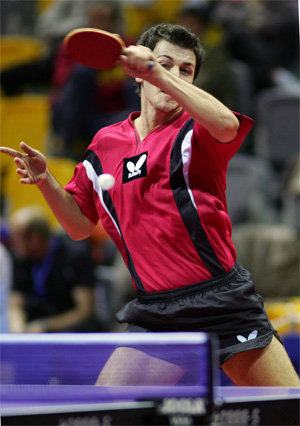
The most important table tennis stroke in the modern game is now the attacking stroke.
That's because the game of table tennis has become a sport that's dominated by attacking / offensive players.
The defensive style of play, once popular in equal measure, has significantly diminished.
So, one of my top table tennis tips for you is ... learn how to play table tennis using an aggressive, attacking style of play rather than any other style.
But of course, before you can play any table tennis stroke, you'll need to master some of the basics first.
TABLE TENNIS EXPERT
REVEALS HIS SECRETS
Click Here For Details

Click here for a large selection of
table tennis equipment at Megaspin *
Click here for a large selection of
table tennis equipment at Bribar *
And that includes using the correct...
Table tennis grip
To play any table tennis stroke effectively, you'll need to ensure that you're using the correct table tennis grip. My guide will help put you on the right track.
^ Top of page ^
Then you can move onto...
Basic ball control
Being able to play a reasonable table tennis stroke relies on good ball control. If you're a beginner, I'd recommend that you use the following exercises to improve your ball control:
- Bounce the ball on the forehand side of your racket, with a bounce height of 30cm (12 inches)
- Repeat 1 above, but use the backhand side of your racket
- Bounce the ball on each side of your racket alternately
- Repeat 1, 2 and 3 but vary the height of the bounce
- Repeat all the above exercises whilst walking or jogging
TABLE TENNIS EXPERT
REVEALS HIS SECRETS
Click Here For Details
Click here for a large selection of
table tennis equipment at Megaspin *
Click here for a large selection of
table tennis equipment at Bribar *
My top table tennis tips:
When practising these exercises, try to ensure that the angle of your elbow is approximately 90 degrees and that you leave a reasonable space between your elbow and your body.
^ Top of page ^
So what table tennis stroke should you learn first?
The basic table tennis strokes
With so many different table tennis strokes to learn, you'll probably wonder where to start.
Well, the easiest table tennis stroke to learn first is the backhand push. Then you should move on to the forehand drive, followed by the backhand drive, and finally the hardest of the four basic table tennis strokes - the forehand push.
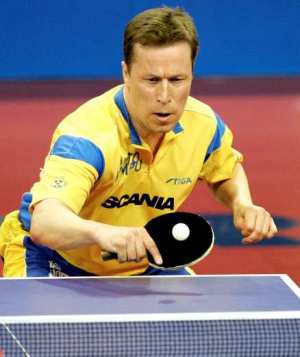
1. The Backhand Push
 by courtesy of the ITTF
To play this stroke, stand close to the table and take a stance facing the line of play.
Using a short stroke, your racket arm should move from the elbow in a horizontal plane whilst your free arm should point towards the ball to assist with your balance.
Hit the ball at the top of the bounce (i.e. when the ball it at its highest point) using 50% of your stroke action before hitting the ball and 50% after hitting the ball.
Strike the ball on the back bottom portion so that you impart slight backspin.
My top table tennis tips:
This shot would normally be used when your opponent plays his shot in such a way that, if you didn't hit the ball, it would bounce at least twice on your side of the table, i.e. short over the net.
The purpose of this stroke is to stop your opponent from playing an attacking stroke, so you should try to make sure that your shot is also played short over the net.
Here's a video demonstration of the backhand push.
(If you have problems with the sound, there are captions/subtitles that you can turn on. Just click on the captions/subtitles button)
^ Top of page ^
TABLE TENNIS EXPERT
REVEALS HIS SECRETS
Click Here For Details
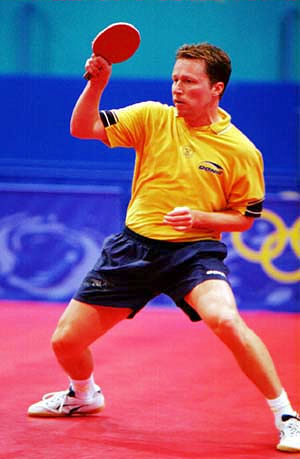
2. The Forehand Drive
 by courtesy of the ITTF
To play this stroke, stand close to the table and take a sideways stance facing the line of play.
Using a medium stroke, your racket arm should move forward and slightly upwards in the direction that the ball is going to travel, whilst your free arm should point towards the ball to assist with your body turn and balance.
During your stroke, your upper body should rotate approx. 45 degrees to the right then turn back to face the ball, whilst your body weight moves from your right foot to your left.
The racket angle should be slightly closed to impart topspin.
Hit the ball at the top of the bounce (i.e. when the ball it at its highest point) using 50% of your stroke action before hitting the ball and 50% after hitting the ball.
My top table tennis tips:
This shot would normally be used when your opponent plays his shot in such a way that the ball approaches you with height and/or depth.
The purpose of this stroke is to play aggressively and stop your opponent from playing an attacking stroke, so you should try to make sure that your shot lands close to your opponent's baseline or sideline.
Here's a video demonstration of the forehand drive.
(If you have problems with the sound, there are captions/subtitles that you can turn on. Just click on the captions/subtitles button)
^ Top of page ^
3. The Backhand Drive
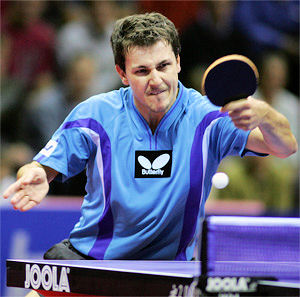 by courtesy of the ITTF
To play this stroke, stand close to the table and take a stance facing the line of play.
Using a medium stroke, your racket arm should move forward and slightly upwards in the direction that the ball is to travel, whilst your free arm should point towards the ball to assist with your balance.
The racket angle should be slightly closed, and by keeping a loose wrist you can impart topspin as you move your arm forward.
Hit the ball at the top of the bounce (i.e. when the ball it at its highest point) using 50% of your stroke action before hitting the ball and 50% after hitting the ball.
My top table tennis tips:
This shot would normally be used when your opponent plays his shot in such a way that the ball approaches you with height and/or depth.
The purpose of this stroke is to play aggressively and stop your opponent from playing an attacking stroke, so you should try to make sure that your shot lands close to your opponent's baseline or sideline.
Here's a video demonstration of the backhand drive.
(If you have problems with the sound, there are captions/subtitles that you can turn on. Just click on the captions/subtitles button)
^ Top of page ^
TABLE TENNIS EXPERT
REVEALS HIS SECRETS
Click Here For Details
4. The Forehand Push
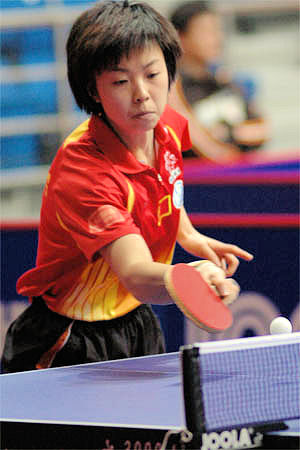 by courtesy of the ITTF
To play this stroke, stand close to the table and take a stance facing the line of play.
Using a short stroke, your racket arm should move from the elbow in a horizontal plane whilst your free arm should point towards the ball to assist with your balance.
Hit the ball at the top of the bounce (i.e. when the ball it at its highest point) using 50% of your stroke action before hitting the ball and 50% after hitting the ball.
Strike the ball on the back bottom portion so that you impart slight backspin.
My top table tennis tips:
This shot would normally be used when your opponent plays his shot in such a way that, if you didn't hit the ball, it would bounce at least twice on your side of the table, i.e. short over the net.
The purpose of this stroke is to stop your opponent from playing an attacking stroke, so you should try to make sure that your shot also stays short over the net.
Here's a video demonstration of the forehand push.
(If you have problems with the sound, there are captions/subtitles that you can turn on. Just click on the captions/subtitles button)
TABLE TENNIS EXPERT
REVEALS HIS SECRETS
Click Here For Details
^ Top of page ^
| MORE PAGES ABOUT HOW TO PLAY TABLE TENNIS |
|---|
For more information on how to play table tennis and improve your game, take a look at my other tips and techniques articles...
Basic Skills
Advanced Skills
Strategies and Tactics
Tips
Skill Tests
Exercises
E-Books
|
Click here for a large selection of
table tennis equipment at Megaspin *
Click here for a large selection of
table tennis equipment at Bribar *
^ Top of page ^
You Are Here: Home » How to Play Table Tennis » 4 Basic Strokes