
You Are Here: Home » Choosing Table Tennis Equipment » Table Tennis Rubber
How To Choose Your Table Tennis Rubber
Top tips to help you choose your ideal table tennis racket.
Part three - what type of table tennis rubber do you need?
By Martin Hughes
Owner and Editor
Part One | Part Two | Part Three | Part Four | Part Five
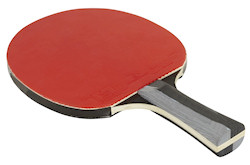
So, if you're following my recommendation to buy a customised racket (part one) rather than a ready-made racket, and you've chosen your table tennis blade (part two), you're now ready to choose your rubbers.
However, this is the stage where many beginners and intermediate players go astray.
You see, because table tennis rubbers are now available in so many different varieties, many players find it very difficult to decide which ones to use.
In addition, many players mistakenly believe that using certain rubbers will elevate their game to new heights, so they only buy the latest or "best" (and most expensive) rubbers.
Well, this is completely unnecessary and will probably damage your game more than help it, and I'll explain why...
TABLE TENNIS EXPERT
REVEALS HIS SECRETS
Click Here For Details

Click here for a large selection of
table tennis equipment at Megaspin *
Click here for a large selection of
table tennis equipment at Bribar *
^ Top of page ^
But first, a word of warning before you choose any table tennis rubber...
The two colour rule
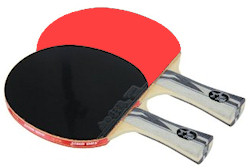
Starting on 1 July 1986 the rules of table tennis stated that one side of the racket must be bright red and the other side must be black.
This rule was introduced because of the increased use of "combination" rackets in the late 1970s and early 1980s.
At that time, players were using the same colour rubber on both sides of their racket, but were using two different types of rubber, and they were then "twiddling" the racket during the rally.
TABLE TENNIS EXPERT
REVEALS HIS SECRETS
Click Here For Details
Click here for a large selection of
table tennis equipment at Megaspin *
Click here for a large selection of
table tennis equipment at Bribar *
This made it very difficult for their opponent to know which rubber was being used for each stroke, and therefore what type of spin was being imparting onto the ball.
So the rules were changed in 1986 so that your opponent would at least know which side of the racket you were using.
But with effect from 1 October 2021, this rule was updated.
You are now allowed to use a bright colour that is clearly distinguishable from black and from the colour of the ball, in addition to red.
The authorised bright colours are pink, purple, green and blue.
So if you're planning on taking part in authorised table tennis events, you need to make sure that you buy the correct colour rubbers.
^ Top of page ^
And, you also need to make sure that you only buy...
Authorised rubbers

Only table tennis rubbers authorised by The International Table Tennis Federation (ITTF) can be used in authorised table tennis events, so you must ensure that the ITTF logo appears on your rubbers.
The inclusion of the ITTF logo signifies that it has been an approved rubber - BUT - the ITTF update their list of authorised rubbers every three months, so you should check that the rubbers you buy are still authorised when you buy them.
Here's an example of the details and logos which appear on the lower portion of Butterfly Tenergy 05 rubbers which have been authorised by the ITTF.

^ Top of page ^
So how do you decide which rubbers you should use?
Choose rubbers which complement your style
When you're choosing which table tennis rubbers to use you should keep it simple and choose rubbers that complement your style.
You see, the simple truth is this...
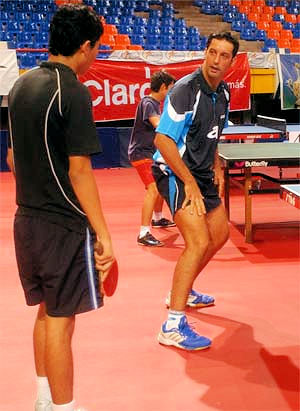
You will improve your game much more by IMPROVING YOUR TECHNIQUE and by PRACTISING MORE OFTEN, than you ever will by choosing any particular rubber.
Once you understand this simple truth, you can forget about trying all the hundreds of different rubbers which are available until such time as your standard improves to a high level.
If you use the rubbers I recommend here, you will have all you need.
The subtle differences between different rubbers (within their own category) are not enough to make ANY difference to the vast majority of players.
Continuous practice with your chosen rubber will yield much better results than continually changing between different rubbers.
^ Top of page ^
So what do you need to know about...
Table tennis rubbers - are they all the same?
There are three main differences you need to be aware of...
1. The thickness of the sponge
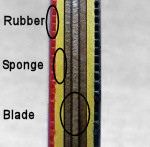
Table tennis rubbers are available in different thicknesses and, as a general rule, the thicker the sponge, the more attacking / offensive the rubber.
For example, a 2.0mm or 2.5mm sponge will be faster and more suitable for an attacking / offensive style of play, whilst a 1.5mm sponge will be a medium speed and give you more control. A 1.0mm sponge will be slower and more suitable for a defensive style of play.
The rubber and sponge are generally pre-assembled as one piece, and it's very unusual to purchase them separately.
2. Pimples-out
Table tennis rubbers can have the pimples (pips) facing outwards or inwards.
Pimpled rubber (pips) has the pimples facing outwards which means that the smooth side of the rubber is attached to the sponge. So you strike the ball with the pimpled surface.
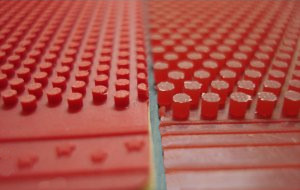
Pimples-out is available in two basic varieties - short pimples or long pimples - and each one gives you a completely different effect when the ball is struck by the pimples.
Short pimples are suitable for players with a fast blocking or counter-hitting game, whilst long pimples are suitable for a more defensive or disruptive style of play. Long pimples can also help you to return attacking / offensive shots with unusual spin.
The majority of pimples-out rubbers have different thicknesses of sponge underneath them, but there are some which do not have any sponge at all underneath them, and these are referred to as "OX" which is an abbreviation for orthodox.
3. Reverse rubber (pimples in)
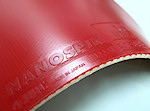
Table tennis rubbers can also have the pimples (pips) facing inwards towards the sponge. You therefore strike the ball with the smooth side of the rubber.
This is known as reverse rubber and is by far the most popular type of rubber as it allows a complete range of strokes to be played.
This type of rubber will give you good control and can help you to develop your strokes, whereas pimpled rubber (pips) is generally designed for advanced players who want to play a particular type of game.
Here's a video I found posted on YouTube which shows how Butterfly blades and rubbers are made in Japan...
Here's a video I found posted on YouTube which shows how Butterfly blades and rubbers are made in Japan...
^ Top of page ^
So let's take a look at...
How to choose your table tennis rubbers
As I said earlier, many players mistakenly believe that using certain rubbers will elevate their game to new heights, so they'll only buy the latest or "best" (and most expensive) rubbers.
However, this is completely the wrong way to choose rubbers and it'll probably damage your game more than help it.
You see, many beginners and intermediate players continually change the rubbers they use, looking for that "magic" ingredient that they hope a different rubber will give them.
But constantly changing your rubbers means that you'll also have to constantly change how you play your strokes. So you'll never perfect a good stroke technique.
So here are my recommendations...
I recommend that you use reverse rubbers.
Additionally, you should use the same type of rubber on both sides of your racket as this will help you to develop your strokes.
Choosing table tennis rubbers is all about choosing ones which complement your style of play, and not about choosing a particular brand, because choosing the right type of rubber is imperative if you want to maximise your chances of improving your game.
So therefore you need to first determine your style of play, and then choose rubbers only from the category which matches your style of play.
All the specialist table tennis equipment suppliers categorise their rubbers, so as long as you choose a rubber from the right category, you can be confident that it'll be right for you.
If you haven't yet determined your style of play, then you should buy a racket which is categorised as Allround, or just buy a ready-made, recreational racket until your game has developed further.
The vast majority of players should choose a blade and rubbers which are in the category "Allround".
Rubbers are sold individually and are approximately 18cm (7 inches) square, and they need to be trimmed to the size of your chosen blade.
^ Top of page ^
So let's take a look at the three basic styles of play and my rubber recommendations for each style...
1. All-round / counter-attacking style
In my experience, the vast majority of players have an all-round, counter-attacking style of play. This means you should use a medium speed rubber which will give you good control.
The vast majority of players should choose this type of rubber.
I recommend the following medium speed rubbers...

Butterfly Sriver 1.5 mm rubber on both sides of your blade. (NOTE: not Sriver FX)
Sriver is one of the most popular rubbers of all-time and is used by a high percentage of top players. The 1.5mm variety will give you great control.
Alternatively, the 1.7mm variety will also give you good control.
You can buy Butterfly Sriver here...
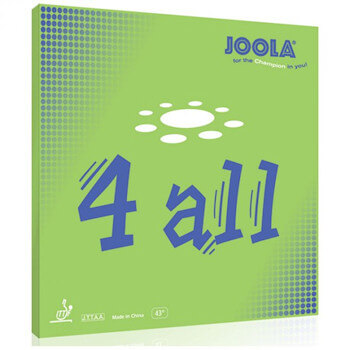
Alternatively, Joola 4 all 1.5mm (or 1.8mm) will also give you good control.
You can buy Joola 4 all here...
2. Attacking / offensive style
If you're an advanced player and you've developed an attacking / offensive style of play, a faster rubber may suit you better. However, a faster rubber means that you'll lose some of the control offered by the slower rubbers.
I recommend...

Yasaka Mark V 2.0mm (or 1.8mm).
You can buy Yasaka Mark V here...

Alternatively, you could use Butterfly Bryce 2.1mm rubber on both sides of your blade.
Bryce is a rubber which incorporates "High Tension". This causes the ball to rebound off the rubber with extra speed.
You can buy Butterfly Bryce here...
3. Defensive style
If you've developed a defensive style of play, a slower rubber will suit you better. However, a slower rubber means that you'll find it difficult to generate the speed of shot offered by faster rubbers.
I recommend...

Butterfly Tackiness Chop II 1.5mm or 1.7mm rubber on both sides of your blade.
Butterfly have now developed this "second generation" of their highly acclaimed Tackiness Chop rubber.
Tackiness Chop-II helps you to produce extra backspin, with maximum control. And it's new sponge now has more rebound and therefore makes attacking easier and more effective.
You can buy Butterfly Tackiness Chop II here...
^ Top of page ^
So, after you've chosen your rubbers, the next important question is ... How often should you change your rubbers?
Changing Your Table Tennis Rubbers
As I said in part one, table tennis rubbers deteriorate with age, so you'll need to replace them at regular intervals.
Dust particles penetrate the rubber causing it to lose its tackiness. And exposure to heat, light and air also causes the rubber to deteriorate.
Professional table tennis players change their rubber extremely frequently - some players change them every day - but they don't have to buy them!
You'll need to change your rubbers when they start to lose their tackiness, so...
I recommend...
Changing your rubbers at least annually.
If you play very frequently, you may find that you need to replace them more often, but annually is sufficient for most players.
Even though you may replace your rubber with exactly the same rubber, I find that they still have different playing characteristics.
I play several times each week, but I only replace mine at the end of every season as I find it takes a while to get used to the new rubbers.
So, now that you've chosen your rubbers, you'll need to know what the rules say about gluing your rubbers onto your blade.
The answer's in part four - choosing your table tennis glue...
^ Top of page ^
Click here for a large selection of
table tennis equipment at Megaspin *
Click here for a large selection of
table tennis equipment at Bribar *
^ Top of page ^
You Are Here: Home » Choosing Table Tennis Equipment » Table Tennis Rubber